


Drama
Drama Overview
Intent
The Drama curriculum at Hope School emphasise creativity, inclusivity, and adaptive teaching, ensuring that our learners can engage meaningfully with creative expression while developing their physical, social, and emotional skills. The Intent is to provide learners with a structured and supportive environment to express creativity and gain confidence through drama and creative expression. The curriculum is fuelled by inquisitiveness and a desire to think about possibilities and concepts through the medium of action. The process allows for all learners to access and become absorbed in dramatic expression on all levels. It allows learners to explore various forms of expression (and can also include art, music and design) as a means of personal expression, communication, and emotional release.
The Drama curriculum promotes sensory exploration enabling learners to engage with a variety of sensory experiences through different media and techniques whilst helping them build sensory awareness.
The Drama curriculum supports cognitive development. This encourages attention and focus, problem-solving, attention to detail, and critical thinking skills through visual and practical learning, as well as enhancing physical skills through physical movement, facial responses, and vocal expression. As learners become progress Drama allows for communication, literacy, and language to become an integral part of the Drama curriculum.
Here at Hope School and College we encourage cultivated inclusion and social interaction. We use collaborative creative projects and group activities to promote teamwork and social interaction across all Key stages.
Our Drama Curriculum can be adapted to individual needs. It provides a flexible learning environment that accommodates diverse needs, abilities, and learning styles, using differentiated instructions. The curriculum is designed to support a diverse range of learning needs, ensuring that all students, regardless of ability, can explore and develop their artistic skills in a safe and nurturing environment.
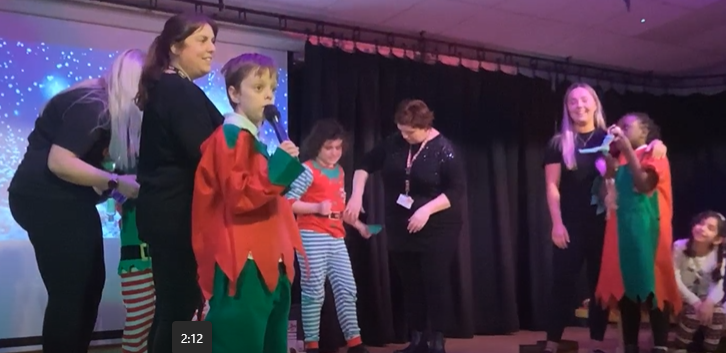
Hope School is An Arts mark school which fosters some elements covered in drama-based events e.g. Christmas performances/end of year assemblies.
Underpinning our drama curriculum are our three core values of Achievement, Equality and Independence.
Implementation
Drama structures at Hope harness teaching strategies that are particularly successful for learners working at all levels of development. Classroom practice will include a clear make-believe context: teacher-in-role, strategic use of costume, props and symbols, adapting a familiar environment to represent a different setting clear cues and signals: cues and signals that make use of all the senses, for example, when sharing a sensory story. Specific tasks with immediate cause-effect consequences in a turn-taking format help replicate the structure of early interaction in dramatic form. Interactive games teach prediction of familiar sequences and patterns in life for example pretending to dress up to go out to work etc
Inclusion of rhythm, rhyme and repetition in chants or songs that frame the turn-taking structure appeal to the linguistic receptiveness of learners at early stages of learning and teaches prediction of familiar patterns and sequences. A deliberate potent focus for attention (attractive object or teacher-in-role) – provides a point for sharing interest and a reason to communicate a whole group experience and teaches skills of group work. This provides opportunity to share in the creation of a collective social meaning through performing arts activities. Drama in small increments helps learners into the symbolism by being actively involved in creating the make-believe and promotes their understanding of representation.
Cross-Curricular Links: Drama is often integrated with other subject areas and topics, enhancing learning through thematic and experiential connections.
Develop Fine and Gross Motor Skills: We deliver unique opportunities to build both fine and gross motor skills. By working within different roles during a drama activity, learners can contribute to the setting through art and design, costume making including textiles, and learners will develop dexterity, hand-eye coordination, and physical strength. Our curriculum is structured to provide activities that support gross motor development at various levels of ability through the dance and drama movement opportunities offered within sessions and performances across the year.
Sensory Exploration: Provide a Sensory-Rich Learning Experience:
We recognise that sensory exploration is a key component in learning for many of our students. Our curriculum integrates a variety of tactile, visual, and auditory experiences that cater to different sensory preferences. Through hands-on activities and multisensory experiences, learners will gain a deeper understanding of the world around them and enhance their sensory processing skills.
At Hope school we have an annual Arts week. The Arts week is themed each year and is timetabled for the whole school to attend and experience. During this week classes from EYFS to FEU can work with external agencies such as musicians, dancers/performers, artists and so much more. We at Hope are lucky enough to have extremely creative staff who also have additional skills and hobbies that are taught to our students, this includes dance and drama. The school comes together across the curriculum sharing experiences and opportunities they have had during the week and is then celebrated during Assemblies and presentations around the school.
These opportunities encourage self-expression without judgment or comparison as well as enhancing social and communication skills.
Impact
The impact of the Drama curriculum is measurable in the following ways:
Increased self-confidence: learners will experience a sense of achievement and pride in their artwork, leading to improved self-esteem and self-worth.
Enhanced communication skills: Drama offers an alternative means of communication, allowing learners who may struggle with verbal expression to convey thoughts and emotions physically.
Development of life skills: learners will adopt important soft skills like patience, persistence, and the ability to work independently or collaboratively.
Improved social interactions: By participating in group activities and projects, learners will develop stronger social bonds and communication skills.
Holistic development: The curriculum aims to support the students’ emotional, cognitive, and physical growth, improving their overall well-being.
Drama Rationale
At Hope School and College our Drama curriculum is designed to provide innovative opportunities to learning through thematic or cross curricular activities. Our progressive and ambitious curriculum is brought to life through immersive, multi-sensory and highly engaging learning experiences. Our Drama content is planned to ensure a breath of study ensuring our learners have opportunities to explore various places, features and cultures.
The teaching of Drama begins with an immersive, communication and practical or multi-sensory approach and develops and progresses in line with the development and ability of learners and their individual need. The curriculum is organised to consolidate prior knowledge, skill and understanding and to build upon what the learner already knows and can already achieve. Drama is developed as part of a wider communication, language and literacy core subject. There are also countless cross-curricular opportunities where Drama can be taught outside of the classroom for example within music, PSHE and on educational visitors e.g. theatrical travelling theatres, story tellers, interactive theatres.
At Hope School and College our learners have very individual needs, and we ensure that all learners are provided with equal opportunities to learn and thrive. Staff will utilise a range of equipment, technologies and resources to provide stimulating and enticing learning activities and environments that are accessible to all. Our learners may also use a wide range of communication methods, which are carefully planned and utilised within lessons ensuring that every learner has a ‘voice’.
Learners may have difficulty generalising skills to new contexts and may require repeated opportunities to consolidate a new skill in one “experience” and transfer this skill across a range of different “experiences”. This repetition opportunities and coverage of Drama is covered in long term plans which ensures coverage and breadth of dramatic expression.
By creating a positive ethos of learning, we aim for our learners to develop their confidence when sharing their subject knowledge, skills, individuality and heritage. Our Drama curriculum is highly individualised and is taught in line with the development and ability of all learners using various teaching methods dependent upon individual pathways, ultimately promoting a love for Drama.
Drama at Hope School and College
Drama in our Early Steps Pathway
Drama is delivered through play-based, sensory-rich activities that encourage exploration, creativity, and communication. Learners engage with a variety of textures, colours, and music and movement to support their creative skills, sensory development, and self-expression. Learning is highly individualized, with a strong focus on process over outcome, and is often integrated with other areas of the Early Years Foundation Stage (EYFS). Activities are delivered in a calm, supportive environment with plenty of adult interaction to model, guide, and respond to each individual’s needs and interests. Drama is integrated into storytelling, circle times and games. Stage performances are introduced in Early Years and Primary with a Christmas performances and Nativity and end of year mini dance performances.

Drama in our Complex Learning Pathway
A fully sensory and experiential approach. Activities are designed to stimulate the senses and encourage interaction, using lights, sounds, textures, and movement. Learning is often delivered on a one-to-one basis, or small group sessions with high levels of support, and closely integrated with physical and sensory therapies. The focus is on engagement, communication, and building trust, with creative experiences adapted to each learner’s physical and cognitive needs. The process, rather than the product, is at the heart of the learning experience.
Drama in our Pre-Formal Pathway
Drama for pre-formal learners is delivered through a sensory-based, exploratory approach that supports communication, engagement, and physical development. Activities are highly individualized and focus on process over outcome, using tactile materials, colours, textures, and movement to stimulate interest and expression. Teaching is often integrated with therapies and delivered in short, engaging sessions with high levels of adult support. The emphasis is on enjoyment, interaction, and developing basic skills such as cause and effect, making choices, and sensory awareness and response. Drama is integrated into storytelling, circle times, games and accompanies music sessions. Performances are designed to allow pre-formal learners to be involved on a level they feel comfortable with fully supported by adults.
Drama in our Semi-Formal Pathway
Drama is taught to semi-formal learners through a cross curricular, flexible and sensory-rich approach. Lessons are tailored to individual needs, focusing on developing creativity, self-expression, and communication. Teachers use visual aids, step-by-step instructions, and hands-on activities to make learning accessible and engaging. Themes are often linked to real-life experiences or cross-curricular topics, annual festivals or celebrations. Progress is measured through personal achievements rather than standard academic benchmarks. Emphasis is placed on enjoyment, exploration, and building confidence.
Drama in our Formal Pathway
Drama for formal learners is delivered through a thematic curriculum and within some structured lessons that closely aligns with national standards but remains adapted to individual learning profiles. Lessons focus on fostering creative intuition skills, creative thinking, and dramatic appreciation. Learners are encouraged to plan, experiment, and reflect on their work. While expectations are higher than for semi-formal learners, teaching remains supportive, using visual prompts, scaffolding, and differentiated instruction to ensure accessibility and success for all learners. Students working on the Formal pathway can work towards Accreditations through ASDAN and Open awards if opted for.